[print-me]

和文は英文の後に続きます。/Japanese translation is on the bottom of this page.
Contents
1. What is the sentence pattern “X wa A ga B”?
2. Examples of “X wa A ga B.”
3. Imagine a “Framed Painting” on the examples
- Ex. 1: Zoo wa hana ga nagai desu. (Elephants have long trunks.)
- Ex. 2: Watashi wa chocoleeto ga suki desu. (I like chocolate.)
- Ex. 3: Watashi wa atama ga itai desu. (I have a headache.)
- Ex. 4: Watashi wa booshi ga arimasu. (I have a hat.)
- Ex. 5: “Oya no oshie to nasubi no hana wa sen ni hitotsu mo ada ga nai” (“Parents’ Teachings and Eggplant Flowers Never Fail to be Valuable.”)
4. FAQ on the “A wa X ga Y” Sentence Pattern
************************
1. What is the “X wa A ga B” sentence pattern?
In our prior post, “Parents’ Teachings and Eggplant Flowers Never Fail to be Valuable”, we mentioned the “X wa A ga B” sentence pattern. It’s actually a very popular sentence pattern in everyday conversation, so we’d like to discuss it in this post.
Have you seen it in one or more of the following examples?
2. The examples of the “X wa A ga B” sentence pattern
- Ex. 1: Zoo wa hana ga nagai desu. (Elephants have long trunks.)
- Ex. 2: Watashi wa chokoleeto ga suki desu. (I like chocolate.)
- Ex. 3: Watashi wa atama ga itai desu. (I have a headache.)
- Ex. 4: Watashi wa booshi ga arimasu.x (I have a hat.)
- Ex. 5: “Oya no oshie to nasubi no hana wa sen ni hitotsu mo ada ga nai” (“Parents’ Teachings and Eggplant Flowers Never Fail to be Valuable.”)
In this sentence pattern, the existence of two subject markers “wa” and “ga” in one sentence sometimes makes students wonder. How should we understand the pattern? Or how should we “feel” what they mean?
3. Imagine a “Framed Painting” on the Examples
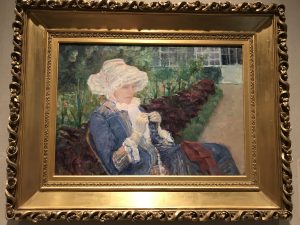
Suppose we would like to say that in this picture, the color of her dress is beautiful.
The title of this painting is “A Knitting Woman (Amimono o shite-iru josei)”. So, we begin our sentence with “Amimono o shiteiru josei wa…” to present the entire picture. Then we direct a spotlight on the dress and describe it. In this case, “…doresu no iro ga suteki desu (the color of her dress is beautiful.)”
この女性(じょせい)のドレスの色(いろ)が美(うつく)しいと言(い)いたいとします。
この絵(え)の題(だい)は「編(あ)み物(もの)をしている女性(じょせい)」です。それで、「編(あ)み物(もの)をしている女性(じょせい)は」と、絵(え)の全体(ぜんたい)を表()すことから文(ぶん)を始(はじ)めます。次にスポットライトをドレスに当て、説明します。「ドレスの色(いろ)が素敵(すてき)です。」
We would like to offer an analogy to “a framed painting”.
In other words, when we encounter this sentence pattern, we analyze it as if we were looking at a painting in a frame with a title, such as one we see in a museum. It works as follows:
Generally, when we hear a word (or words) followed by “wa”, we recognize it as the subject, topic, the context or the background information that the speaker wants to share with us. Then the next part usually explains what the subject does or how it is.
However, if we hear the second word followed by “ga” after the “wa” block, we immediately switch our mode to that for the “X wa A ga B” sentence pattern. We need to get the meaning accordingly.
With the “X wa A ga B” sentence pattern, first, the word followed by “wa” is the resemblance of the title of a painting.
Next, the following part, “A ga B”, resembles one part of the picture receiving a spotlight. In this part, “A” is the actual subject of the sentence and “B” is its predicate. In other words, “B” is directly connected to “A” grammatically and semantically, and explains the state of “A”.
Finally, the spotlighted picture that A and B present is still a part or a constituent of the bigger picture “X”.
Let’s look at the examples again with the framing-picture image.
Ex. 1: Zoo wa hana ga nagai desu. (Elephants have long trunks.)
To talk about one part of something, we frequently use this sentence structure.
“Zoo” is followed by “wa” so it is the “title of the painting”. You now know that we are going to tell about the elephant.
Actually we can say many things about an elephant. It is as if you could draw pictures of many parts of an elephant under the title “zoo”. For example, after “Zoo wa… (as for the elephant)”, you can continue:
- …hana ga nagai desu. (literally, the nose is long = The elephant has a long trunk.)
- …mimi ga ookii desu. (lit., the ears are big = The elephant has big ears.)
- …ashi ga hutoi desu. (lit., the legs are thick = The elephant has thick legs).
- …atama ga ii desu. (lit., the head is good = The elephant is smart.) or
- …zooge ga toremasu. (lit., you can get ivory = You can get ivory from them.)
Ex. 2: “Watashi wa chokoreeto ga suki desu.” (I like chocolate.)
When we say we like or love something, we frequently use the “X wa A ga B” sentence pattern.
“Watashi” is the “title” since it’s followed by “wa”.
“Chocoreeto ga suki desu.” means “chocolate is like-able/attractive.”
Therefore, literally translated, it is “As for me, chocolate is like-able/attractive.” This is how the Japanese say “I like/love chocolate”.
Ex. 3: “Watashi wa atama ga itai desu.” (I have a headache.)
We also use the “X wa A ga B” sentence pattern when we talk about the condition of our body parts.
“Watashi” is the “title” since it’s followed by “wa”.
“Atama ga itai desu.” means “the head is painful.”
Literally translated, it is “As for me, the head is painful.” This is how we say “I have a headache.”
Note: “Suki” (Ex. 2), “itai” (Ex. 3) and some other adjectives for feelings and emotions directly express those of the speaker. Therefore, if you hear someone say “Atama ga itai…” “Chokoreeto ga suki desu.” without the word with “wa”, it’s about the speaker. Also, if someone says, with a rising intonation,“Chokoreeto ga suki?” “Atama ga itai?”, he/she is asking about YOU.
Ex. 4: “Watashi wa booshi ga arimasu.” (I have a hat.)
In Japanese, the “X wa A ga B” sentence pattern is also used to express possession.
“Watashi” is the “title of the painting” since it’s followed by “wa”.
“Booshi ga arimasu” means “a hat exists.”
Literally translated, it is “As for me, there is a hat.” This is how the Japanese say “I have a hat.”
Note: In Japanese, whenever understandable from the context, we may omit the subject from a sentence. If you don’t hear the subject, it is usually about the speaker or the same as the most recently mentioned subject. For example, “Booshi ga arimasu.” may also be interpreted as “I have a hat.”
Ex. 5: “Oya no oshie to nasubi no hana wa sen ni hitotsu mo ada ga nai” (“Parents’ Teachings and Eggplant Flowers Never Fail to be Valuable.”)
This is a longer sentence but we will work on it since we explained this proverb in another post.
Here, too, you can say many things about her. We will show you some examples with verbs and a noun for “B”:
“Oya no oshie to nasubi no hana” is the “title” since it is followed by “wa”.
Then comes the statement “ada ga nai” (waste doesn’t exist).
In English, you could say “Speaking of parents’ teachings and eggplant flowers, there is no waste at all”, meaning each word of our parents has a great value.
By the way, “Sen-ni hitotsu mo” (not one in a thousand) emphasizes “nai” (doesn’t exist).
4. FAQ on the “A wa X ga Y” Sentence Pattern
In our next post, we will discuss two of the most popular questions on the “A wa X ga Y” sentence pattern: FAQ on the “X wa A ga B” Sentence Pattern.
[End of the post]
Related Posts
- The Particle “wa” (は)
- FAQ on the “A wa X ga Y” Sentence Pattern
- [Link coming soon] A Proverb “Parents’ Teachings and Eggplant Flowers Never Fail to be Valuable.”
=>Return to Recent Posts/「新着記事」へ戻る
=>Return to Home/「ホーム」へ戻る
[End of the English post]
*************************************
「XはAがB」の文型のとらえかた試論
目 次
1. 「X は A が B」の文型とは?
2. 「X は A が B」 の例文
3. 「額に入った絵」のイメージと例文
- 例1: 象は鼻が長いです。
- 例2: 私はチョコレートが好きです。
- 例3: 私は頭が痛いです。
- 例4: 私は帽子があります。
- 例5: 「親の教えとなすびの花は千にひとつも無駄がない」
4. 「X は A が B」の文型について、よくある質問
************************
1.「XはAがB」の文型とは?
以前の投稿「親の教えとなすびの花は千にひとつも無駄がない」で、「XはAがB」の文型についてふれました。これは日常生活でとてもよく使われるので、ここではこの文型について考えたいと思います。
次の例文のどれかを見たことがありませんか。
2.「XはAがB」文型の例文
- 例1: 象は鼻が長いです。
- 例2: 私はチョコレートが好きです。
- 例3: 私は頭が痛いです。
- 例4: 私は帽子があります。
- 例5: 「親の教えとなすびの花は千にひとつも無駄がない」
この文型には、文中に主語を示す「は」と「が」が両方あるので、どういうことだろうという声をときどき聞きます。この文型をどう理解すればよいでしょうか。あるいは、意味をどう「感じ取ったら」いいでしょうか。
3.「額に入った絵」のイメージと例文
この文型を「額絵」のようなものと考えてみます。
つまり、このような文に出会ったら、題のついた額に入った、美術館にあるような絵を想像して分析するのです。
まず、一般に、「は」を従えた言葉を聞いたら、それが話し手の聞き手と共有したい主語、話題、文脈あるいは背景だと考えます。普通はこの後に、その主語がすることや、主語の状態を説明する部分が来ます。
しかし、この「は」のついた言葉の後に「が」のついた言葉が来たら、すぐ「XはAがB」の文型モードに切り替え、その文型として理解するのです。
この文型では、まず、「は」のついた最初の言葉は「題のついた額絵」に似ています。
そのあとに来る「AがB」の部分は、絵の中の一部分にスポットライトが当たっている感じです。この部分では、Aが実際の主語で、Bがその述語です。BはAに文法的にも意味的にも直結して、Aの状態を説明しています。
そして、このスポットライトの当たったところは、やはり大きな絵であるXの一部分、または構成要素なのです。
例をもう一度見て、額縁と絵のイメージで分析してみましょう。
例1: 象は鼻が長いです。
何かの一部分について話す時、「XはAがB」の文型をよく使います。
この場合、「象」は「は」の前にあるので、「絵の題名」になります。これで、私たちが象の話をしようとしていることがわかります。
私たちは、象についていろいろなことを述べることができます。「象」という題のもとで、象のさまざまな部分にスポットライトを当てる感覚です。例えば、「象は……」の後、次のようにいろいろと文を続けることができます。
- ……鼻が長いです。
- ……耳が大きいです。
- ……足が太いです。
- ……頭がいいです。
- ……象牙が獲れます。
例2: 私はチョコレートが好きです。
好きなもののことを言う時、よく「XはAがB」の文型を使います。
「私」の後に「は」がついているので、これが「絵の題」です。
「チョコレートが好きです」は、文字通りには「チョコレートは好ましい・惹き付ける」という意味です。
ですから、直訳すれば「私について言えば、チョコレートは好ましいものだ・惹き付ける」ですが、これが日本人の、I like chocolate. の言い方です。
例3: 私は頭が痛いです。
私たちは体の部分の状態を言う時も、「XはAがB」の文型を使います。
「私」の後に「は」がついていますから、これが「絵の題」です。
直訳すれば「私について言えば、頭が痛い」となります。
注: 例2の「好き」、例3の「痛い」その他、感じや感情についての形容詞は、話し手のそれを直接表すことがあります。そのため、「頭が痛い」「チョコレートが好きです」などと「は」を伴う言葉のない文を聞いた場合、それは本人のことです。また、誰かが上がり調子で「チョコレートが好き?」「頭が痛い?」などと言ったら、その人はあなたの気持ちや感じを尋ねていることになります。
例4: 私は帽子があります。
日本語では、所有を表す時も、「XはAがB」の文型を使います。
「私」の後に「は」がついていますから、これが「絵の題」です。
文字通りに訳すと、「私について言えば、帽子が存在します。」になります。I have a hat. は日本語ではこのように言います。
例5: 「親の教えとなすびの花は千にひとつも無駄がない」
これは長い文ですが、他の投稿でこのことわざを扱ったので、見てみましょう。
「親の教えとなすびの花」は「は」を従えているので、「絵の題」です。
英語では、「親の教えとなすびの花について言えば、ひとつも無駄がない。つまり、どれにも大きな価値がある」ということになるでしょう。
なお、「千にひとつも」は、「ない」を強調しています。
4. 「X は A が B」の文型について、よくある質問
次の投稿 =>FAQ on the “A wa X ga Y” Sentence Patternでは、よくある質問の二つについて考えます。
[和文部終わり]
関連リンク
- 英文部末尾をご参照ください。
=>Return to 2019 Posts / 2019年投稿記事へ戻る
=>Return to Home/「ホーム」へ戻る