Contents
- In short: The particle “no” (の) is a possessive marker
- A bit more on the particle “no” (の): Its other meanings, shortened expression, and on the repetition of the [Noun + “no”] block
- Bonus: The use of the particle “no” (の) for apposition and as the subject marker
************************
1. In short: The particle “no” (の) is a possessive marker
The particle “no” makes the preceding word possessive. Usually, the particle “no” comes between two nouns and shows that the second noun belongs to the first one.
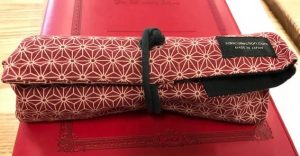
Example 1: これは私のペンケースです。Kore wa watashi no pen-keesu desu. (This is my pen case.)
2. A bit more on the particle “no” (の): Its other meanings, shortened expression, and on the repetition of the [Noun + “no”] block
(1) Other meanings of the particle “no”
You can use “no” to connect nouns with different relationships than the possessive or “belonging to…”:
Ex. 2: これは英語の本です。Kore wa eego no hon desu. (This is a book written in English. /This is a book on the English language.)
Ex. 3: これは映画の本です。Kore wa eega no hon desu. (This is a book on movies.)
Ex. 4: これはヤギのチーズです。Kore wa yagi no chiizu desu. (This is cheese made from goat’s milk.)
(2) Shortened expression with the particle “no”
We often omit the noun after “no” when the listener knows what we are talking about from the context.
Ex. 5: これは誰のですか?Kore wa dare no desu ka? (Whose is this?) [We omit the word for the object such as “kasa (umbrella)” after “dare no (whose)” if we are showing the umbrella to you.]
Ex. 6: この鳥のから揚げはおとといのです。Kono tori-no-karaage wa ototoi no desu. (This fried chicken is from the day before yesterday.) [We don’t repeat “tori-no-karaage” after “ototoi no”.]
(3) On the repetition of the [Noun + “no”] block
To say “something belonging to another thing belonging to another thing belonging to…” you can repeat the [noun + “no”] block, but maybe up to three times.
Ex. 7: これは母のお気に入りの緑のスカーフです。Kore wa haha no o-ki-ni-iri no midori no sukaahu desu. (This is my mom’s favorite green scarf.)
Ex. 8: これは母のお気に入りの緑のスカーフの写真です。Kore wa haha no o-ki-ni iri no midori no sukaahu no shashin desu. (This is the photo of my mom’s favorite green scarf.) [It might sound too many “no” in the sentence and perhaps you would be out of breath, although you would get the meaning across.]
3. Bonus: The use of the particle “no” (の) for apposition and as the subject marker
(1) “no” can explain by rewording
To explain something, we sometimes offer two different words to refer to it, such as “This is my sister Erika”. Both of the words “My sister” and “Erika” mean the same person. In Japanese, we use “no” to connect them.
Ex. 9: これは妹のえりかです。Kore wa imooto no Erika desu. (This is my sister Erika.)
Ex. 10: これは私の宝物の切手のコレクションです。Kore wa watashi no takara-mono no kitte no korekushon desu. (This is my treasure, my stamp collection.) [Both “watashi no takaramono (my treasure)” and “kitte no korekushon (stamp collection)” refer to the same thing.]
(2) “no” can be a subject marker in a subordinate clause
You may see “no” after the subject in a subordinate clause, particularly when it modifies a noun. This “no” shows the subject in the clause. The meanings of Ex. 11 and 12 are exactly the same.
Ex. 11: これはミラーさんの作ったケーキです。Kore wa Miraa-san no tsukutta keeki desu. (This is cake that Mr. Miller made.)
Ex. 12: これはミラーさんが作ったケーキです。Kore wa Miraa-san ga tsukutta keeki desu. (This is cake that Mr. Miller made.)
Related Posts
- [Next Post] The Particle “e” (へ)
- Particles and Their Related Verbs
- [Previous Post] The Particle “wa” (は)