Tea Olive (Osmanthus Fragrans)
Contents
- Flower scent
- Tea Olive (Osmanthus Fragrans)
- Ghin-Mokusei (Osmanthus Fragrans)
- Kin-Mokusei (Osmanthus Fragrans var. aurantiacus)
- Osmanthus Tea
- Ghin-Mokusei (Osmanthus Fragrans) and Kin-Mokusei (Osmanthus Fragrans var. aurantiacus)
- ルビ付き和訳 (Japanese translation)
****************************************
1. Flower scent

Fall came earlier than usual.
When I was taking a walk, something reminded me of the feeling of early fall in Charleston.
I stopped in the middle of the way and looked around.
A nostalgic, sweet flower smell like fruity gardenia was in the warm, humid air.
But I couldn’t tell where the flowers were just by looking around.
I could perceive this scent in many parts of the city; on the path through the fields, in residential areas, in parking lots.
What was it? I was very interested in the first fall after my moving.
I asked my neighbors and posted a photo of a “suspicious” tree on Facebook, where an old student identified it for me. He used one of his “apps”, I had never been so impressed by modern technology.
One name for the tree is Tea Olive.
2. Tea Olive (Osmanthus Fragrans)
Tea Olive trees can be of a person’s height or can reach the roof of a house, and the shape of the tree is varied, but in general, they look rather inconspicuous.
Also, the flowers look like someone tore up white, crumpled crape myrtle flowers, and inserted each piece between the leaves and a branch. You hardly see them from afar.
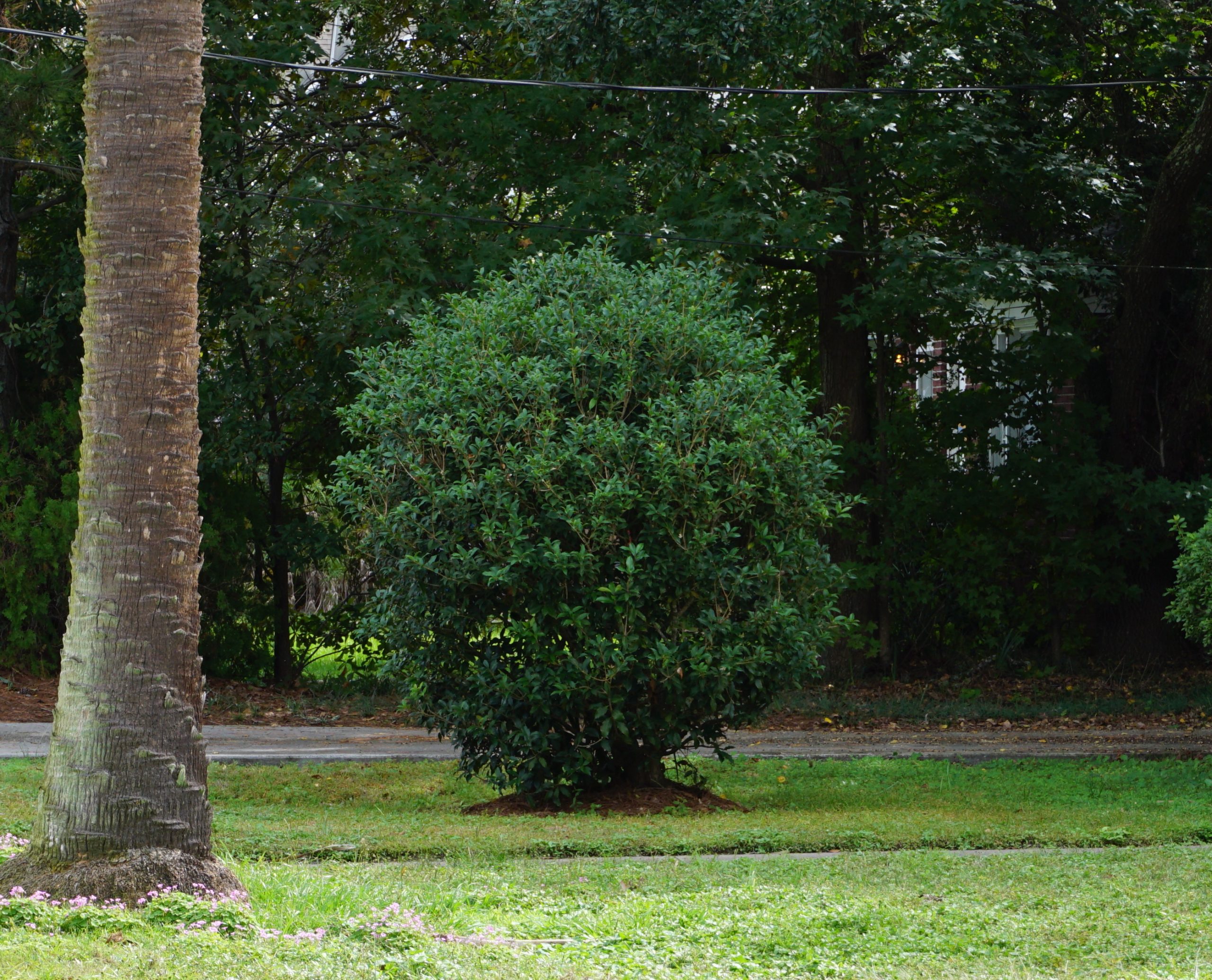
However, the tree is very “vocal”.
When I walk in town thinking about something, suddenly I feel a blanket of fragrance thrown over me.
Surprised, I look around. It is a Tea Olive tree standing in someone’s yard, and it can be ten meters (thirty feet) behind me.
It feels as if it were saying,
“Hey, I say ‘hello!’”
and it makes me smile.
3. Ghin-Mokusei (Osmanthus Fragrans)
Tea Olive is translated as “Ghin-Mokusei” or “Mokusei” in Japanese. “Ghin” means silver, and “Mokusei” is the name for its family and its genus. It seems that trees of this kind, if not exactly the same as Tea Olive, have existed in Japan for a long time.
The Ghin-Mokusei has the same Latin name as Tea Olive, and its lowers symbolize “Integrity” which derives from the image of pure white flowers.
As I was looking around on the Internet, I found a Japanese business running several care facilities and group homes for the elderly needing nursing service, whose name is “Gin-Mokusei”.
It was a little unexpected but “Gin-Mokusei” is a good name.
“Ghin (silver)” can be a poetic way of describing gray hair.
Its elegant sweet odor is very charming, so people of all ages would be happy to liken themselves to it.
4. Kin-Mokusei (Osmanthus Fragrans var. aurantiacus)
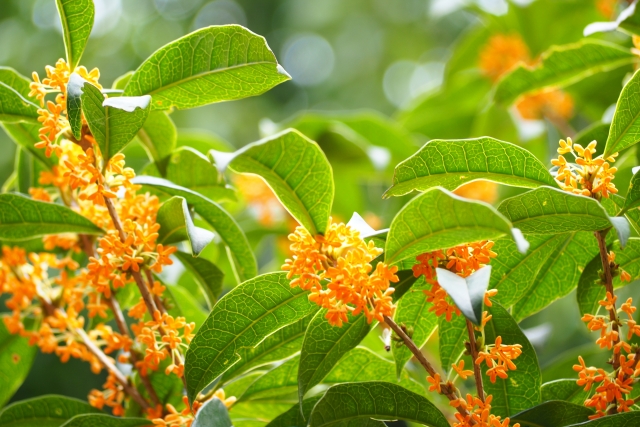
In today’s Japan, however, it is its variety, Osmanthus Fragrans var. aurantiacus (fragrant orange-colored olive) which is popular. We often see them in people’s gardens and parks.
We will refer to it as “Kin-Mokusei”, the shorter Japanese name. “Kin” means “gold”.
It came to Japan from China during the Edo Era (1603-1868).
Its flowers contain carotenoid which explains the orange color.
Since the fragrance of Kin-Mokusei is so powerful, it is dubbed “Ku-ri koo (9 ri or very far-reaching fragrance)”.
Taking advantage of the strong sweet scent, people used to plant Kin-Mokusei near their bathrooms when there were no or few flushing toilets. Probably based on that tradition, chemically composed Kin-Mokusei-scented deodorant for the bathroom was very popular when I was small.
Also, some temples and shrines have planted them believing that the fragrance deters evil spirit.
5. Osmanthus Tea
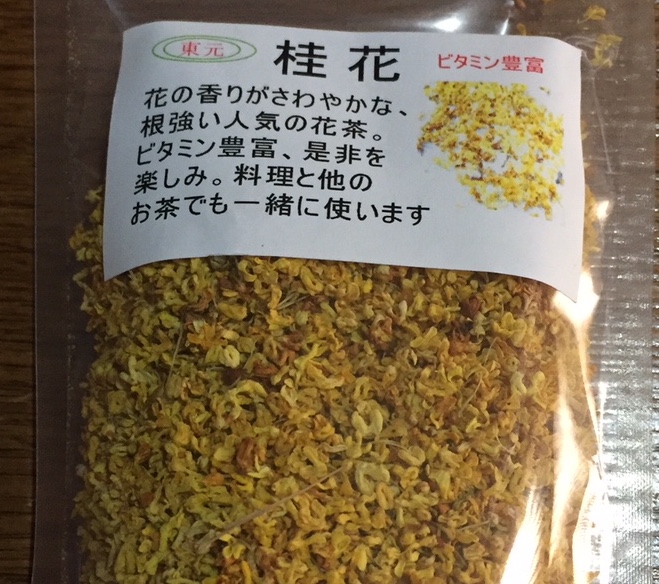
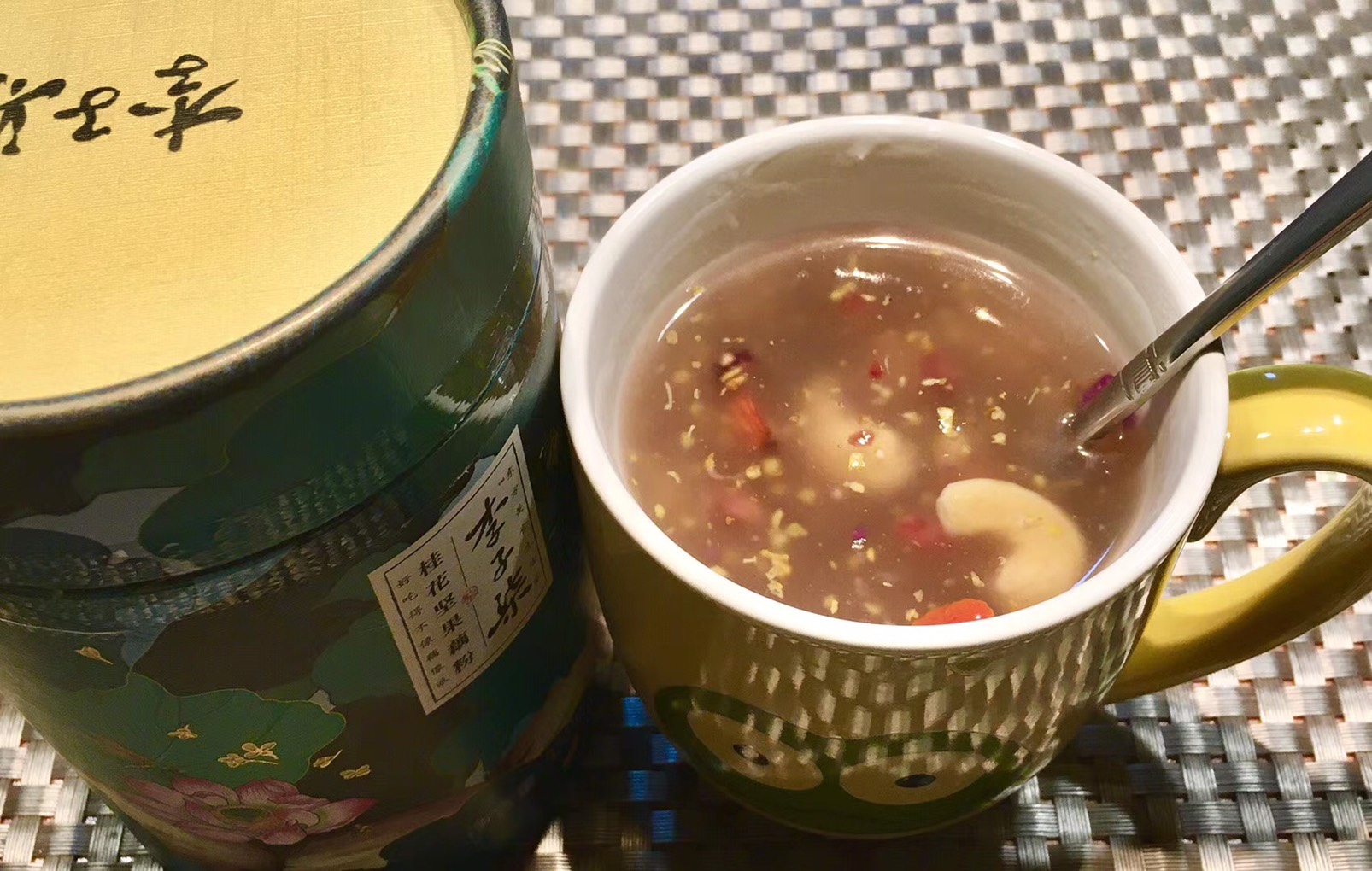
In China and Taiwan, they also love Kin-Mokusei’s fragrance. They infuse its scent in tea and liquor, they make candy of the flowers, and I have seen on YouTube a bowl of shaved ice with Kin-Mokusei-flavored syrup on it!
“Keika-cha” is the word for tea scented with any flower of the genus Osmanthus, and you can make keika-cha at home with fresh flowers.
According to a recipe, you pick the flowers which are about to open (when their scent is at its height) and mix them with green tea or lightly fermented black or Oolong tea. Use two parts of tea for every one part of the flowers. Pour very hot water (90 degrees Celsius or 195 degrees Fahrenheit) over the mixture and enjoy.
6. Ghin-Mokusei and Kin-Mokusei
In Japan, it is said that Kin-Mokusei smells stronger than Ghin-Mokusei.
However, the odor of Charleston’s Ghin-Mokusei spreads so widely that I was a little doubtful. I could find no testimony from Japan of someone who actually smelled both flowers.
Fortunately, I found an interesting website of a nursery in Georgia, USA, where they grow both Gin-Mokusei and Kin-Mokusei for sale.
And the people have actually smelled both.
The strength of the odor was not mentioned, but they say the smells are subtly different and Kin-Mokusei has a stronger sweet element.
I will be interested in growing Kin-Mokusei in the future, because it will be as beautiful and it seems they consider its scent more Asian.
But first things first; two years ago, we planted a small Ghin-Mokusei or Tea Olive like our neighbors.
I hope it grows healthily and begins to “talk (smell profusely)” with its scent in our yard.
And one day, I will be able to make Osmanthus Tea.
[End of the English post]
****************************************
ぎんもくせい
目次
- 花の香り
- ティー・オリーブ
- ぎんもくせい
- きんもくせい
- 桂花茶
- ぎんもくせいときんもくせい
****************************************
1. 花の香り
例年より秋の訪れが早かったチャールストンです。
散歩していて、チャールストンの初秋の感覚を思い出しました。
道の真ん中でとつぜん立ち止まり、きょろきょろと四方を見回してしまったのです。
熟した桃のような、くちなしのような、なつかしい甘い花の香りが、雨上がりの、温かい湿気の中に漂っています。
でも、ちょっと見回しただけでは、どこにその花が咲いているのかわかりません。
この匂いが、散歩道や住宅街、駐車場など街のあちこちに流れます。
引っ越してきたとき、とても興味を持ちました。
近所の人に聞いたり、それらしい木の写真をフェースブックに投稿して昔の生徒さんに調べてもらったりした末、やっとわかりました。その生徒さんはあるアプリを使って見つけてくれたのです。現代のテクノロジーはすごいですね。
この木は、「ティー・オリーブ」などと呼ばれています。
2. ティー・オリーブ
ティー・オリーブの木は、人の背丈ぐらいとか、家の軒ぐらいとか、高さも、形もいろいろですが、あまり目立たない雑木に見えます。
花も、白い百日紅のくしゃくしゃの花をちぎって、葉と枝の間にちょこんちょこんと差し込んでいったような感じ。遠目には見えないほどの小ささです。
ところが、どの木もとても「雄弁」です。
というのは、考え事をしながら歩いていても、ふわっと毛布がかぶさったように温かい、いい匂いがしてきます。
びっくりして見回すと、10メートルぐらい後方にティー・オリーブの木があった、ということがよくあるのです。
それが、
「ねえ、こんにちはってば!」
と言っているようで、ついにこにこしてしまいます。
3. ぎんもくせい
ティー・オリーブは、日本語では「ぎんもくせい (銀木犀)」「もくせい (木犀)」。全く同じではないかもしれませんが、この種の木は日本には昔からあったようです。
現代のぎんもくせいはティー・オリーブと同じラテン名で、花言葉はその純白の花のイメージから「高潔」。
インターネットでいろいろ見ていたら、「ぎんもくせい」という日本の介護サービスつき高齢者向け居住施設ビジネスが出てきました。
ちょっと驚きましたが、考えてみれば、「ぎんもくせい」はなかなかよいネーミングです。
銀は、白髪の詩的な言い方でもあります。
優雅な芳香で愛される木、どんな年齢の人でもあやかりたいと思うでしょう。
4. きんもくせい
一方、今日の日本で親しまれているのは、ぎんもくせいの変種である「きんもくせい (金木犀)」です。庭や公園でよく見かけます。
きんもくせいは中国から、江戸時代に入ってきたそうですが、花にカロテノイドが含まれていてオレンジ色。
とても香りが強いので、別名九里香(九里=とても遠くまで届く香り)といわれます。
その甘い香りを利用して、水洗トイレがなかった、あるいは少なかった時代は、日本の家では、きんもくせいをよくお手洗いのそばに植えたそうです。その名残だと思いますが、私の子供時代、きんもくせいの合成香料のトイレ消臭剤は、とてもポピュラーでした。
また、この香気が邪気を払うとして、お寺や神社などにも植えられていることがあります。
5. 桂花茶
中国や台湾でも、きんもくせいはとても愛されていて、花の香りを移したお茶やお酒、砂糖漬けなどがあります。動画できんもくせいフレーバーのシロップをかけたかき氷を見たことがあります!
もくせいの花のお茶は桂花茶というそうで、花が咲いたら自宅でも淹れられるとか。
緑茶や発酵度の浅い紅茶・ウーロン茶など2に対してきんもくせいの咲き掛けの花1の割で混ぜ、熱めのお湯(摂氏90度、華氏200度ぐらい)で淹れて飲むというレシピを見かけました。
6. きんもくせいとぎんもくせい
日本ではぎんもくせいよりきんもくせいの方が香りが強いと言われています。
でも、チャールストンのぎんもくせいがとても香るので、本当かなあと思っていました。日本のサイトで両方の香りを比べてみた人の話はなかなかないのです。
幸い、米国ジョージア州の植木屋さんのサイトを見つけました。
そこではぎんもくせいときんもくせいを両方扱っていて、そこの人たちは実際にかいでみたそうなのです。
強さのことは書いてありませんでしたが、香りはかすかに違い、きんもくせいの香りには甘さがより際立っているそうです。
きんもくせいも美しい木だし、香りはよりアジア風と思われているようなので、将来的には庭に植えてみたいです。
でも、とりあえず、ご近所のように、ぎんもくせいの木を植えたのです。
その木に順調に成長して、庭で「しゃべる (すごく香る) ようになって」欲しい。
いつか、桂花茶を淹れられるかもしれません。
[和訳終わり]