和訳は英文の下にございます。/ Japanese translation with ruby on kanji is below the English text.
Migrating Butterflies
Contents

1. A butterfly with writings
2. The migrating butterfly
3. Marking survey of the Chestnut Tiger
4. The migration of the Chestnut Tiger
5. The world's longest-distance migrator butterfly
6. The Monarch Butterfly
7. The wisdom of the migrating butterflies
1. A butterfly with writings
Do you like butterflies?
We had an opportunity to learn about some butterflies this fall, and we became very interested.
The beginning was a photo from Japan on Facebook.
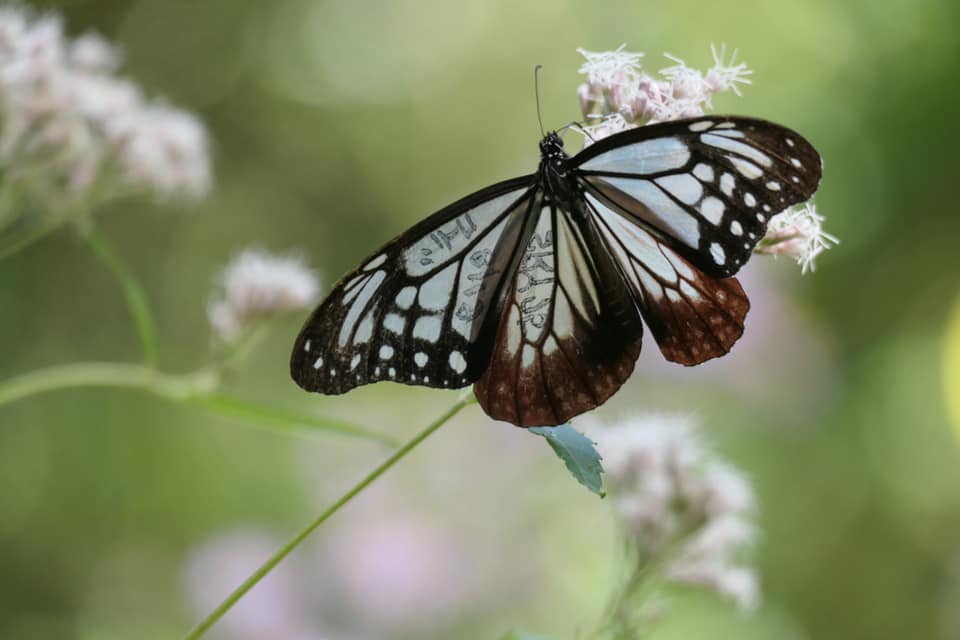
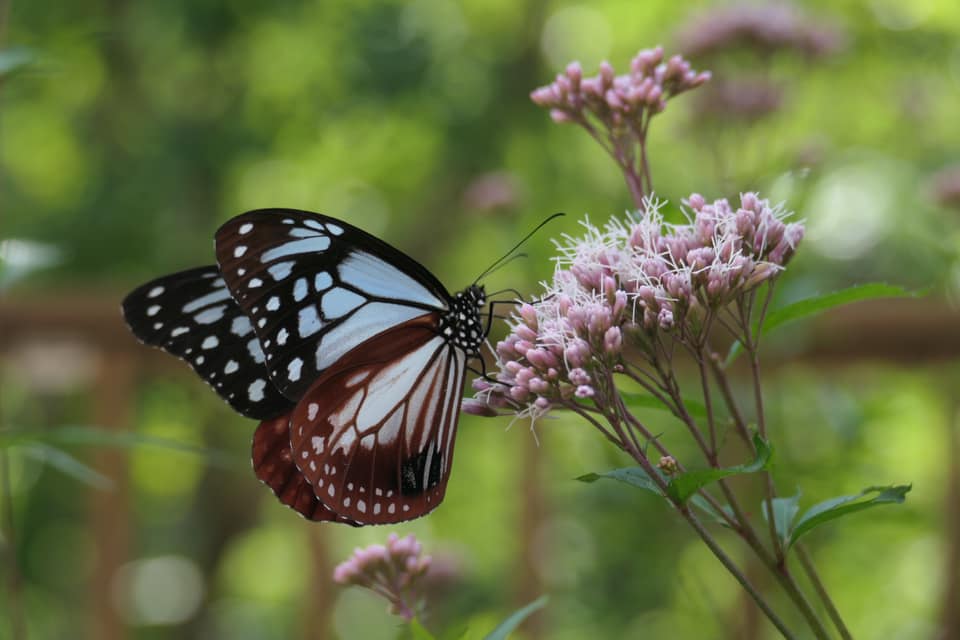
It focused on an ethereal pale blue butterfly, which was taken in Kyoto Botanical Gardens.
However, it seemed that someone had caught it and written something on its wings!
Why did they do that? If you would write on the wings, wouldn’t it hurt it?
2. The migrating butterfly
Answering my question, the lady who posted the photo said these are migrating butterflies.
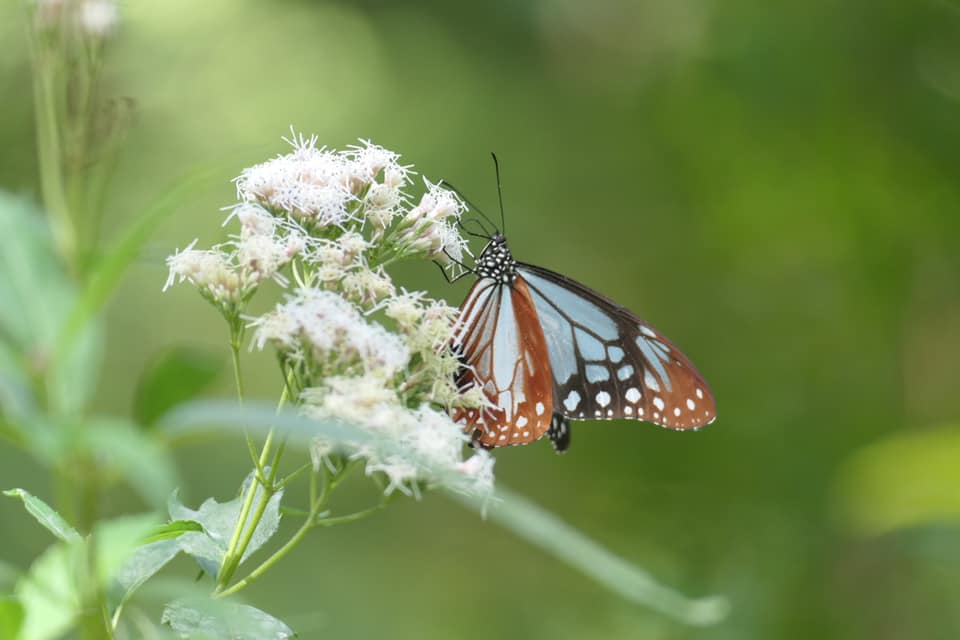
“They fly from the Tohoku or Kanto region all the way to Okinawa and Taiwan!
“I hear that various organizations are conducting marking surveys to find about their routes.”
This butterfly is called “Asaghi-Madara” in Japanese. It is about four inches wide with its wings spread out. “Asaghi” means very pale blue with a hint of green, and “Madara” means spotted or speckled.
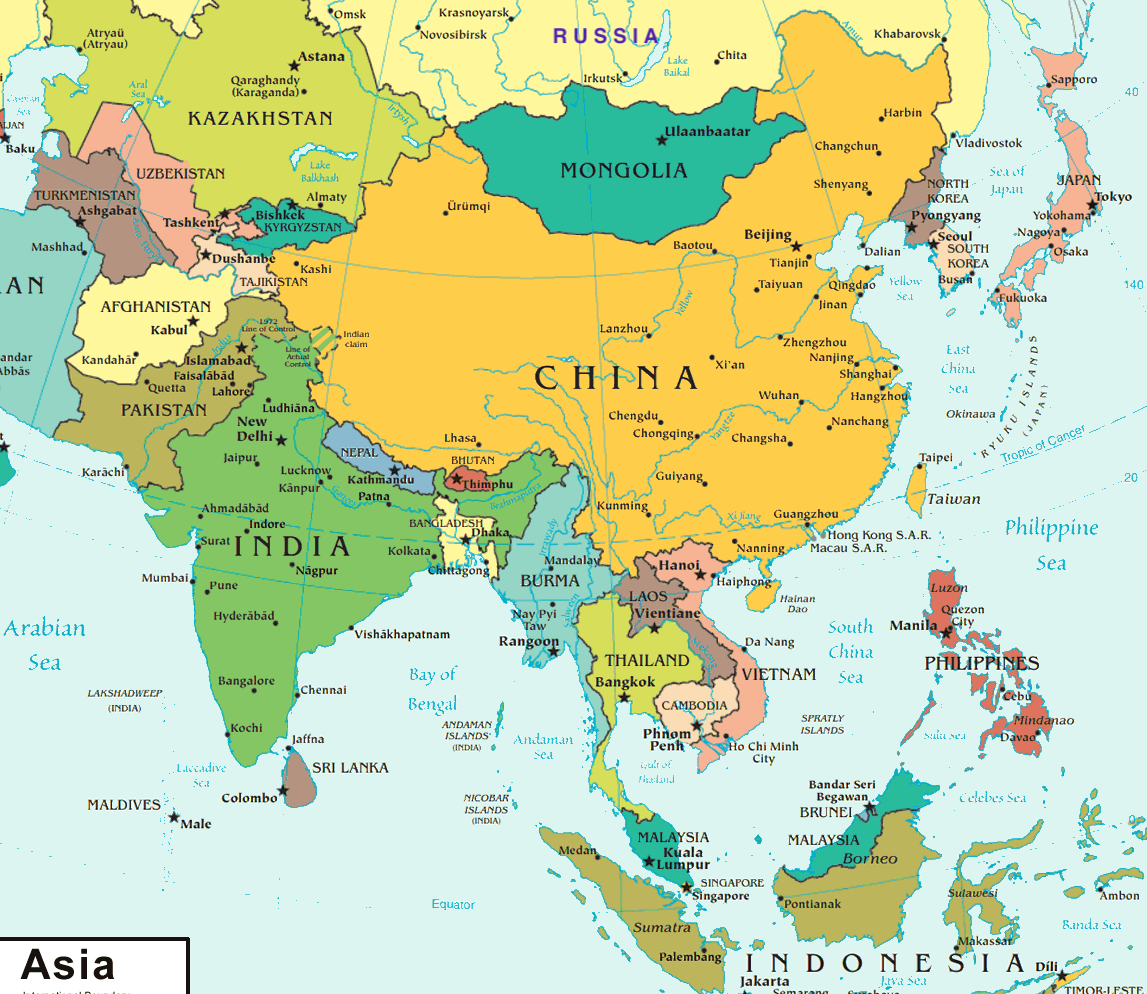
In English they are called the Chestnut Tiger, and their scientific name is Parantica sita. They are found widely in Asia from around Afghanistan, Pakistan, northern India, Nepal, Tibet, Bangladesh, Bhutan, Southeast Asia, southern China, Taiwan, the Korean Peninsula, to the Japanese Archipelago.
In Japan, people didn’t know the Chestnut Tiger migrates until recently.
3. Marking research of the Chestnut Tiger
“Recently” or in the beginning of the 1980’s, some people in Japan thought the Chestnut Tiger might be migrating. They marked them on Tanegashima Island, Kagoshima-ken, and let them free in 1981. Later that year, one was caught in Fukushima-ken and another in Mie-ken. The news of this success made the marking survey of the Chestnut Tiger in Japan very popular.
With migrating birds, you do “banding” to conduct a survey. With the Chestnut Tiger butterflies, the Japanese catch one, mark the place, date, marker’s name, and the serial number of the marking with a pen. Since the Chestnut Tiger doesn’t have scale powder, permanent ink stays on the wings. It is said that their flight and mating are not affected adversely by this marking.
Then they release it, and if someone catches it somewhere else on a later date, they can tell how many days it took that butterfly to cover what distance, and in which direction it travelled. Also, they can take a photograph and see how it is worn out after the travel, and report it to their club, researchers, a natural museum or a botanical garden.
Many people and children have participated, and since the 2000’s, tens of thousands of Chestnut Tigers have been marked each year.
However, we can’t tell a simple story about their migration. The re-catching rate is about 1%, and the distance and direction are so varied. Also the organizations and researchers conducting the surveys are only loosely connected, and it seems that there is no comprehensive report based on all the surveys.
Still, we learned some very interesting stories and we would like to share them with you.
4. The migration of the Chestnut Tiger
The Chestnut Tiger is originally a tropical butterfly and hates cold weather, but they are also very weak in extreme heat.
Therefore, in spring and summer, the Chestnut Tiger in Japan travels to places of an elevation of 1,000 meters or higher, or in the direction of northeast.
In summer and fall, they begin to travel south, mate and lay eggs, and then end their lives.
When the new generation reaches adulthood, they travel further south. They reach their destination and lay eggs. When they hatch, they overwinter in the form of larvae. When spring comes, they METAMORPHOSE into butterflies and set out on their journey north again.
In other words, basically, one generation spends its life in a one-directional travelling.
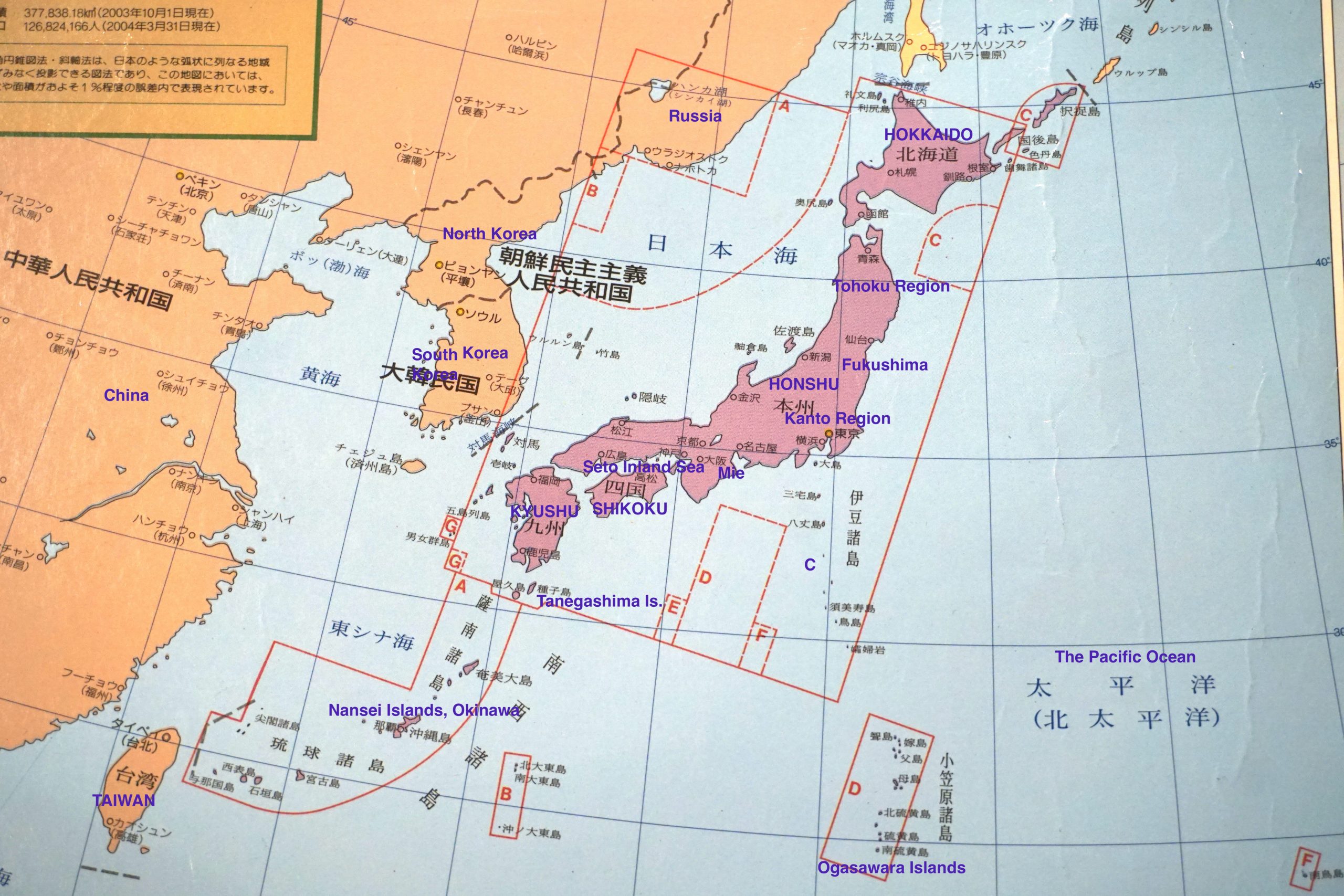
Their places to overwinter are scattered wildly; areas on the Pacific Ocean in Kanto and westward regions in Honshu, Seto Inland area, Kyushu, the Nansei Islands IN Okinawa and Taiwan, among others.
Looking at the map, we wonder. They may be able to ride on an air current, but can they rest on the water? Once offshore, they don’t eat anything? It must be particularly hard to travel in the season of typhoons.
There are many mysteries about the Chestnut Tiger; extraordinary vitality and will power, complicated behaviors, ability to know the oncoming inclement weather from afar and to avoid it, and why they migrate thus. However, their lives spent in great adventures have made a lot of fans among the Japanese.
5. The world’s longest-distance migrator butterfly
When I, as a new fan, was reading about the Chestnut Tiger, a sentence caught my attention:
“The Chestnut Tiger has the record of the second longest flight (2, 246 km) among the world’s butterflies.”
I hardly knew about butterflies, so I didn’t know their travelling distance was so unusual. Who migrates the longest distance?
It was “Ookaba-Madara” in North America; they fly about 5,000 km.
I had never heard about “Ookaba Madara”. In the dictionary, it was “Monarch Butterfly”.
Their photographs surprised me.
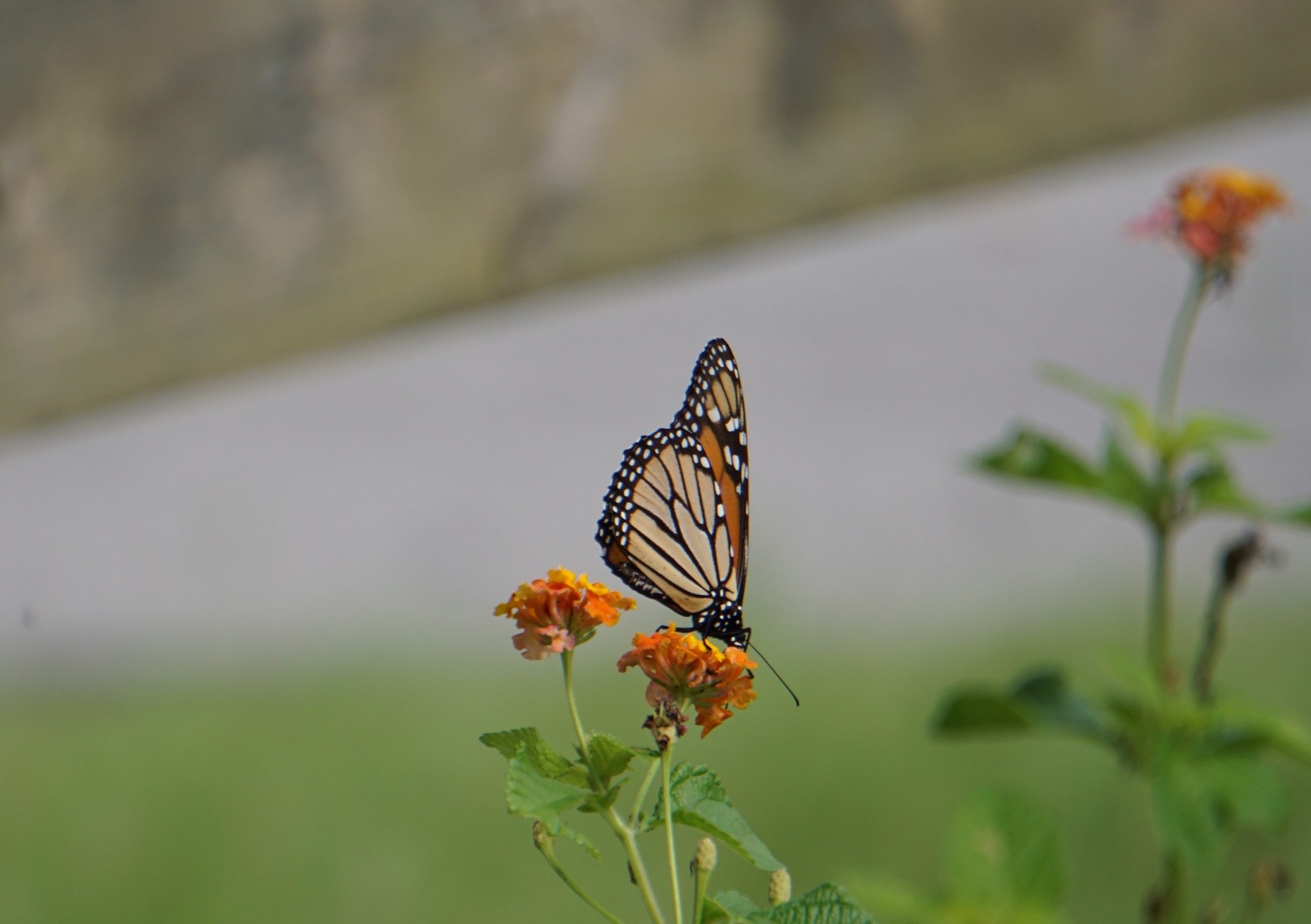
In September, I took some photos of those butterflies while taking a walk in Charleston without knowing their name.
6. The Monarch Butterfly
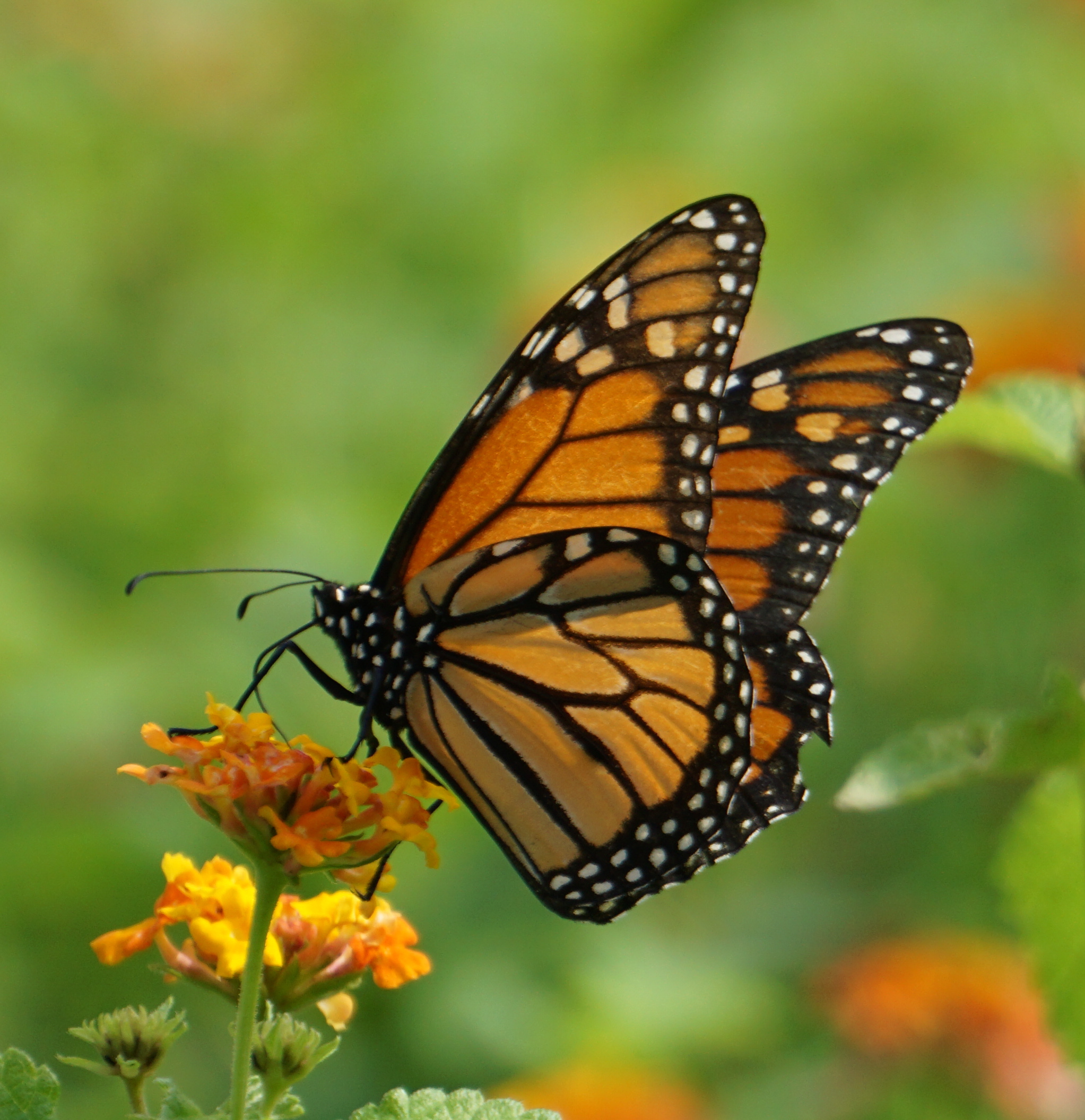
Many Monarch Butterflies migrate by travelling north to the US or Canada in the spring, and travelling to the mountains in southern Mexico in the fall.
It means maybe the Monarchs I saw were in transit to Texas and then the Oyamel Mountains in Mexico!
In the US, the study of the Monarch’s migration began in the 1950’s. It was thirty years before the Japanese noticed the migration of the Chestnut Tiger, so it seems that they learned a lot from American studies on their migrating butterfly. In the marking of the Monarchs, though, Americans do not write on but affix a tiny sticker on a wing.
If you would like to know a little more about the Monarch, below is a very interesting and informative link: https://www.fs.fed.us/wildflowers/pollinators/Monarch_Butterfly/migration/index.shtml
Americans watch the Monarchs very carefully. Some consider the sharp decline in their number in the last forty years as a warning to the changes of their ecosystem.
On the other hand, the study of the Chestnut Tiger in Japan is still in the stage of finding their routes in migration. Still, some already suspect such environmental issues as divisions of forests for development and road construction, the rise in temperature, the decrease of plants they feed on caused by invading species, are affecting their number and behavior.
7. The wisdom of the migrating butterflies

The lady who showed us the Chestnut Tiger photos said that they actually visited the garden of her home.
We, as we are living in the US, would like the Monarch Butterfly to drop in at our garden. We are planning to plant milkweed and other plants for them.
Larvae of both Monarchs and Chestnut Tigers eat the leaves of plants of the family Apocynaceae. They are poisonous, and the larvae absorb the poison. Thus, when another insect or a bird eats them, it may find they taste awful and may not eat the others.
The larvae can’t fight for themselves, but they may be able to let other and future larvae survive by being eaten. It’s a defense system of the species.
Their risky, long journey is also wisdom to give birth to the next generation where it’s easier to live.
All creatures may be similarly doing something for their future generations.
What can humans do to let our future generations live more easily and happily?
[End of the English post]
**********************************************
渡りをする蝶
目次 1. 書き込みのある蝶 2. 渡りをする蝶 3. アサギマダラのマーキング調査 4. アサギマダラの季節移動 5. 世界で一番長距離を渡る蝶 6. オオカバマダラ 7. 渡りをする蝶の知恵
****************************************
1.書き込みのある蝶
蝶って、お好きですか。
この秋は、蝶について少し知る機会があり、とても興味をもつようになりました。
きっかけは、フェースブックで見た、ある日本の写真です。
京都府立植物園で撮った写真の中に、この世のものと思われないような美しい水色の蝶がいたのです。
でも、誰かがつかまえて、羽にペンで何か書き込んだらしい。[英文部の写真をご参照ください]
なぜそんなことを? ……字を書いたりしたら、羽を傷つけてしまうのでは?
2. 渡りをする蝶
質問をすると、写真を投稿した方が教えて下さいました。この蝶は「渡り」をするのです。
「東北・関東から沖縄、台湾まで飛んで渡っていくんですよ!
「その渡りのルートを解明するために、いろいろな団体がマーキングして確認しているそうです」
この蝶の名は 日本語ではアサギマダラ (浅葱斑)。羽を広げると10センチほどになります。名前の「あさぎ」は薄い緑色がかった青色、「まだら」はいくつかの色が所々に交じっていることです。
英語ではチェスナット・タイガー、学名Parantica sitaといい、アジアではアフガニスタンあたりからインド北部、ネパール、ブータン、東南アジア、中国南部、台湾、朝鮮半島、日本列島まで、広く見られます。[CIAのアジア地図をお借りしましたので、英文部をご参照ください]
日本では、季節移動することは最近まで知られていませんでした。
3. アサギマダラのマーキング調査
最近といっても1980年代の初めですが、アサギマダラが季節移動をするのではないかと考えた人たちがいました。1981年に、鹿児島県の種子島でマーキングして放したアサギマダラが、福島県と三重県で再捕獲されました。このことがきっかけになり、日本のアサギマダラ・マーキング調査が始まったのです。
渡り鳥の調査では、「バンディング (足環をつけること)」をします。アサギマダラでは、蝶を捕まえて、場所、日時、捕獲者、今年何頭目めの蝶か、などを油性ペンで羽に直接記入します。アサギマダラは鱗粉がないので、油性インクが載ります。なお、このようなマーキングは、飛行や交尾に支障を来さないそうです。
マーキング後に放した蝶を後日他の場所で再捕獲すると、その蝶が何日間でどのくらい、どの方角へ移動したかわかります。また、写真を撮って旅の後の摩耗状態を見て、同好会や研究者団体、地元の自然博物館や植物園に報告したりするのです。
2000年代に入ると、一般の人々や子供たちも併せて、毎年数万頭にマーキングが施されるようになりました。
といっても、アサギマダラの渡りをひとつの筋書きに絞ることはできません。再捕獲の確率は1%程度ですし、移動の距離、方向のばらつきが大きいのです。マーキング調査にかかわる団体や研究者はゆるくつながっているけれど、すべてをまとめた調査報告は出ていないようです。
それでも、いくつかとても面白い話を聞いたので、皆さまとシェアしたいと思います。
4.アサギマダラの季節移動
アサギマダラはもともと熱帯の蝶で寒さを厭いますが、猛暑も苦手。
そのため、日本では、春から夏にかけては、標高1,000メートル以上の高地、あるいは北東の方向へ移動します。
夏から秋になると、アサギマダラは南方へ移動を始めますが、このころ交尾産卵を行い、命を終えます。
新しい世代が成虫になるとさらに南下し、目的地で次の世代を生みます。その世代は、幼虫のままそこで越冬し、春に成虫になって、ふたたび北への旅に出ます。
すなわち、基本的にひとつの世代が生涯を渡りの片道旅行にかけるのです。
越冬地は、関東以西の太平洋岸、瀬戸内海地方、九州、沖縄の南西諸島や台湾その他さまざまで、地図を見ると、不思議になります。気流に乗るとしても、波の上で休めるのでしょうか? 沖に出たら食べるものもないのでは? 台風の季節に旅をするのはさぞかし大変でしょう![地図は英文部をご参照ください]
アサギマダラには、桁外れの生命力と意志力、複雑な行動パターン、遠くから悪天候を感知して避ける能力、そしてなぜこのような渡りをするのかなど、多くの謎があります。でも、その大冒険にかける生涯を知って、多くの人がファンになりました。
5. 世界で一番長距離を渡る蝶
新米ファンの私がアサギマダラについて読んでいたら、こんな文が目に留まりました。
「アサギマダラは世界で二番目に長い飛行距離 (2,246キロ) が確認された」
蝶についてよく知らなかったので、アサギマダラの渡りはそんなに珍しいのかと思いました。最長距離を渡る蝶は誰だろう?
それは、北米の「オオカバマダラ (大蒲斑?)」、飛距離は約5,000キロだそうです。
聞いたことがなかったので、辞書を調べると英語で Monarch Butterfly (モナーク・バタフライ)でした。
写真を見てびっくりしました。
9月のある日、散歩の途中で見かけて、名前も知らずに撮った蝶たちだったのです。[写真は英文部のオレンジっぽい蝶をご覧ください]
6. オオカバマダラ
オオカバマダラの多くは、春は米国やカナダへ北上し、秋にメキシコ南部の高山地方へ、毎年大移動をします。
ですから、チャールストンで私が見かけた小さな群れは、テキサスを経てメキシコのオヤメル山脈へ行く途中だったのかもしれません!
米国のオオカバマダラの季節移動研究は、1950年代に始まりました。日本でアサギマダラの渡りに気づく30年前ですから、アサギマダラの研究は、米国のオオカバマダラの研究にいろいろ学んでいるでしょう。ただ、米国ではマーキングするのに、羽に小さなシールを貼るようです。
米国では、オオカバマダラを注意深く観察しています。最近40年ぐらいで確認された個体数の激減を米国のエコシステムの変化への警鐘とする人もいます。
一方、アサギマダラ研究はまだルート解明の段階ですが、道路建設や土地開発のための森林分断、気温上昇、侵入種植物による食草減少などが、アサギマダラの数や行動に影響しているとも言われています。
7. 渡りをする蝶の知恵
蝶の写真を見せてくださった方は、ご自宅のお庭にアサギマダラが来たそうです。[写真は英文部をご覧ください]
うちは米国なので、オオカバマダラにぜひ立ち寄ってほしい。オオカバマダラの幼虫が食べる植物トウワタ (唐綿) を植えようと思っています。
オオカバマダラも、アサギマダラも、キョウチクトウ科の有毒の草木の葉を食べます。
幼虫はその毒を体内に採り入れます。自分を食べる鳥や動物がまずいと知って、他の個体を食べなくなるように。
自分のために戦うことはできないけれど、食べられることによって仲間の、あるいは次世代の幼虫が生き延びられるかもしれない、「種」を守る知恵です。
危険な長い旅を冒すのも、より生きやすい環境で次世代を生んでやる知恵です。
生き物はみんな、未来の世代のためにそういうことをしているのかもしれません。
人間は、未来の世代がより楽に幸せに生きるために、どんなことができるでしょう。
[和文部終わり]